How to Style Expressive Clothes Without Looking Fake

Quick Summary
Expressive clothes look fake when too many bold pieces compete at once, so start with one statement piece and keep everything else plain. Check context, fit, and coordination before buying more. Wear new bold pieces in low-stakes settings until they feel like yours.
- Start with one statement piece and keep the remaining pieces plain in color and simple in shape.
- Expressive clothes look fake for four reasons: context mismatch, fit disconnect, over-coordination, and unfamiliarity.
- Limit your palette to two or three colors so the outfit feels controlled rather than random.
- Fix shoulder seam, sleeve length, and hem before adding boldness, since poor fit makes loud prints look sloppy.
- Wear a new statement piece in low-stakes settings first until it feels comfortable and like your own.
Table of Contents
- Why Expressive Clothes Look Fake on Some People
- Start With One Statement Piece, Not a Full Costume
- How to Wear Graphic Tees Without Looking Like a Costume
- How to Style Oversized Hoodies for Men With Bold Pieces
- How to Balance Colors in an Outfit So It Feels Intentional
- Common Styling Pitfalls That Make Expressive Outfits Look Forced
- Build Your First Expressive Outfit This Week
- Frequently Asked Questions
Start With One Statement Piece, Not a Full Costume
Most people who look like they're wearing a costume aren't wearing too many bold pieces. They're wearing too many bold pieces at once. The fix is to start with one.
Here's the thing about expressive clothing. It only looks fake when everything competes for attention. A single graphic tee, a loud hoodie, or a bright cap can carry a whole outfit when the rest stays quiet.
Watch out: Buying a full head-to-toe bold look in one order is the fastest way to end up with a closet of pieces you never wear.
Last Updated: October 26, 2026
Why Expressive Clothes Look Fake on Some People
Expressive clothes look fake when the outfit feels like a costume rather than a choice. That usually happens because the person is wearing a statement they haven't grown into yet. The clothes say something the wearer doesn't feel.
Research on how clothing signals identity and self-expression
But "confidence" is only part of the story. In practice, most fake-looking outfits fail on one of four concrete mechanisms. Diagnose which one applies to you before you buy another bold piece.
1. Context mismatch. The same graphic tee reads as personal at a weekend market and as a costume at a formal office. Expressive clothing looks authentic when it fits the room. A loud print in a setting where everyone else is in muted tailoring doesn't signal self-expression, it signals that you didn't read the room.
2. Fit disconnect. A bold piece amplifies whatever the fit is doing. A boxy graphic tee on a frame that needs structure reads as borrowed; the same tee with a clean shoulder seam and the right length reads as chosen. Before you blame the print, check the shoulder seam, the sleeve length, and the hem. Most "fake" looks are actually fit problems wearing a loud shirt.
3. Over-coordination. When every piece is making a statement, loud print, loud accessory, loud shoes, loud color, the eye has nowhere to rest, and the outfit reads as a costume. Authentic expressive style usually has one or two focal points and a quiet supporting cast. If you can't identify which piece is the lead, neither can anyone else.
4. Unfamiliarity. New clothes feel like costumes for the first few wears because you haven't built the muscle memory of how you move in them. A common pattern is that people abandon a bold piece after one uncomfortable outing, then conclude expressive clothing "isn't them." Wear a new statement piece in low-stakes settings first, a coffee run, a casual Friday, until it feels like yours.
Confidence matters more than the print itself. A bold piece worn with ease reads as personal. The same piece worn stiffly reads as borrowed, but ease is usually the result of getting context, fit, coordination, and familiarity right, not a personality trait you either have or don't.
Start With One Statement Piece, Not a Full Costume
Begin with a single standout item and build the rest of the outfit around it. Keep the remaining pieces plain in color and simple in shape.
A clean base makes a bold piece look deliberate. Try black, white, grey, or muted tones under a loud graphic.
Browse statement streetwear options to find one piece that fits your taste before adding more.
How to Wear Graphic Tees Without Looking Like a Costume
A graphic tee looks premium when the fabric, print, and fit all feel considered. Cheap prints crack and fade quickly. Good ones hold their color and feel soft after many washes.
Look for these details when you shop:
- Heavy cotton with a dense weave
- Clean print edges with no visible cracking
- A fit that matches your body, not a trend
Pick a funny graphic tee that doesn't look cheap by checking fabric weight and print quality before you buy.
Choosing a Graphic That Fits Your Lifestyle
Choose a graphic you can wear across several settings. A joke that works at a concert may feel out of place at work. Pick designs that match how you actually spend your week.
The Men's You're Boring Graffiti Tag is made from 100% cotton with a 240g/m² fabric weight and a classic fit. It works well as an everyday base because the classic cut suits most body types.
Men's You're Boring Graffiti Tag →
How to Style Oversized Hoodies for Men With Bold Pieces
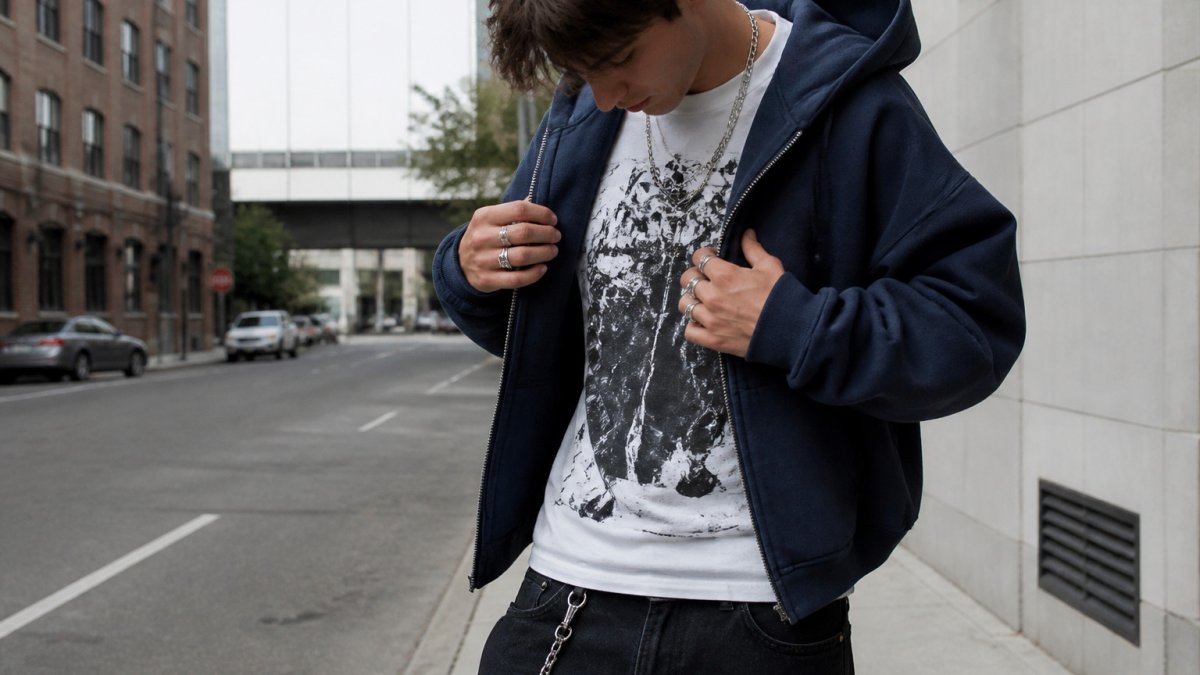
An oversized hoodie looks intentional when the proportions balance. Pair the loose top with slimmer pants or a straighter leg, and pick simple shoes that don't fight the hoodie.
Here is a simple formula to try:
- Oversized hoodie as the main layer
- Slim or straight-leg dark jeans
- Clean sneakers in a neutral color
- One bold accessory, like a cap
The Oversize Fleeced Hoodie gives you that relaxed silhouette in sizes S through 2XL. Keep the rest of the outfit simple so the hoodie does the talking.
How to Balance Colors in an Outfit So It Feels Intentional
Balance colors by limiting your palette. Two or three colors look controlled. Five or six start to look random.
Try this approach:
- Choose one bold color as the focus
- Add one neutral base color
- Use a third color only in small doses, like a cap or socks
A bold print works well when its darkest color repeats somewhere else in the outfit. That repetition ties the look together. For more outfit formulas and print-mixing rules, see how to wear bold prints confidently.
The Graffiti Mad Face Blue cap and the Graffiti Mad Face Red cap both offer a single bold color you can repeat across an outfit.
Common Styling Pitfalls That Make Expressive Outfits Look Forced
Most forced looks come from a few repeat mistakes. The list is short, but each one has a specific cause and a specific fix, knowing the fix is what separates an outfit that looks intentional from one that looks like a costume.
Pitfall 1: Wearing every bold piece at once. This is the most common one. The cause is treating each bold piece as an independent decision instead of part of a single composition. The fix: build the outfit around one focal point and let everything else support it. If the graphic tee is the lead, the hoodie, pants, and shoes should be quiet.
Pitfall 2: Mixing too many prints in one outfit. Two prints can work together, but only when they share a color, a scale, or a visual language. A small checker and a large graffiti print fight each other; a graffiti print and a tonal camo in the same color family can coexist. The fix: if you want two prints, tie them with one shared color and keep one of them small-scale.
Pitfall 3: Choosing clothes that don't fit well. Bold clothing magnifies fit problems. A loud print on a poorly fitting tee reads as sloppy, while the same print on a well-fitting tee reads as deliberate. The fix: get the shoulder seam, sleeve length, and hem right first, then add boldness. Fit is the foundation; expression is the paint.
Pitfall 4: Buying trends you don't actually like. This is the quiet one. A trend can look great on someone else and feel like a costume on you because you're wearing someone else's taste. The fix: before buying, ask whether you'd wear the piece if no one else were wearing it. If the answer is no, it's a costume, not a choice.
A common mistake is buying for an imagined version of yourself, the person you'd be if you were braver, cooler, or lived in a different city. Buy for the person you are this month. Expressive style built on who you actually are reads as authentic; style built on a fantasy version of yourself reads as a costume every time.
One more pitfall worth naming: over-accessorizing to "complete" a look. A cap, a chain, a ring, and a bag on top of a bold tee is four statements competing. Pick one accessory that echoes the outfit's main color or theme, and let the rest go.
The four most common styling mistakes that make a bold outfit look forced, each with its cause and fix.
| Pitfall | Cause | Fix |
|---|---|---|
| Wearing every bold piece at once | Treating each bold piece as a separate decision | Build around one focal point |
| Mixing too many prints | Prints share no color, scale, or visual language | Tie prints with one shared color |
| Poor fit | Bold clothing magnifies fit problems | Fix shoulder, sleeve, and hem first |
| Buying trends you don't like | Wearing someone else's taste | Ask if you'd wear it with no one else wearing it |
Build Your First Expressive Outfit This Week
Start small and build over time. Pick one statement piece this week, wear it with plain basics, and notice how it feels. Next week, add one more piece if the first one still feels like you.
By the end of a month, you'll have a set of pieces that work together and reflect how you actually want to dress.
Frequently Asked Questions
How do you wear bold clothes without looking like you're trying too hard?
Pick one expressive piece per outfit and keep everything else quiet, in neutral colors and simple fits. Wear the piece the way you would wear any everyday item, with no extra accessories competing for attention. Fit matters more than the design: a graphic tee or hoodie that sits well on your shoulders looks deliberate, while an ill-fitting bold piece looks like a costume. Give yourself a few weeks of wearing the same piece in different combinations so it starts to feel like part of your normal wardrobe rather than a special occasion outfit.
How can I make a statement piece feel natural in an outfit?
Anchor the statement piece with basics you already own, such as plain black or grey trousers, a clean sneaker, and a simple cap or none at all. Repeat one color from the statement piece in a small detail elsewhere, like shoes or a bag, so the look feels coordinated. Avoid adding a second loud item at the same time. When you wear the piece often and in ordinary settings, such as a coffee run or a casual dinner, it stops looking staged and starts looking like you.
How do you balance graphic clothing with the rest of an outfit?
Let the graphic carry the outfit and keep the other pieces in a narrow range of colors and textures. A plain black or white graphic tee pairs well with straight-leg denim or cargo pants and a structured cap. If the graphic is busy, choose solid, low-contrast bottoms and avoid patterned accessories. Check the outfit in a mirror from a distance: if nothing else stands out, the balance is working.
What should I wear with an oversized hoodie?
Oversized hoodies work best with fitted or straight-cut bottoms, such as slim jeans, tapered joggers, or cargo pants with a clean hem, so the proportions stay balanced. Shorter sneakers or simple boots keep the silhouette from looking shapeless. Add one defined element, like a flat-brim cap or a watch, to show the outfit was chosen on purpose. Keep the hoodie in a solid color if the bottoms are busy, and reserve graphic hoodies for simpler lower halves.
Ready to start? Shop the Oversize Fleeced Hoodie or pick up the Men's You're Boring Graffiti Tag and build your first bold outfit from one piece you actually like.


Don't be boring.
Hoodies, tees and hats that say what everyone's thinking. Free US shipping over $70.
Shop the drop

